Customer Deployment Recipes
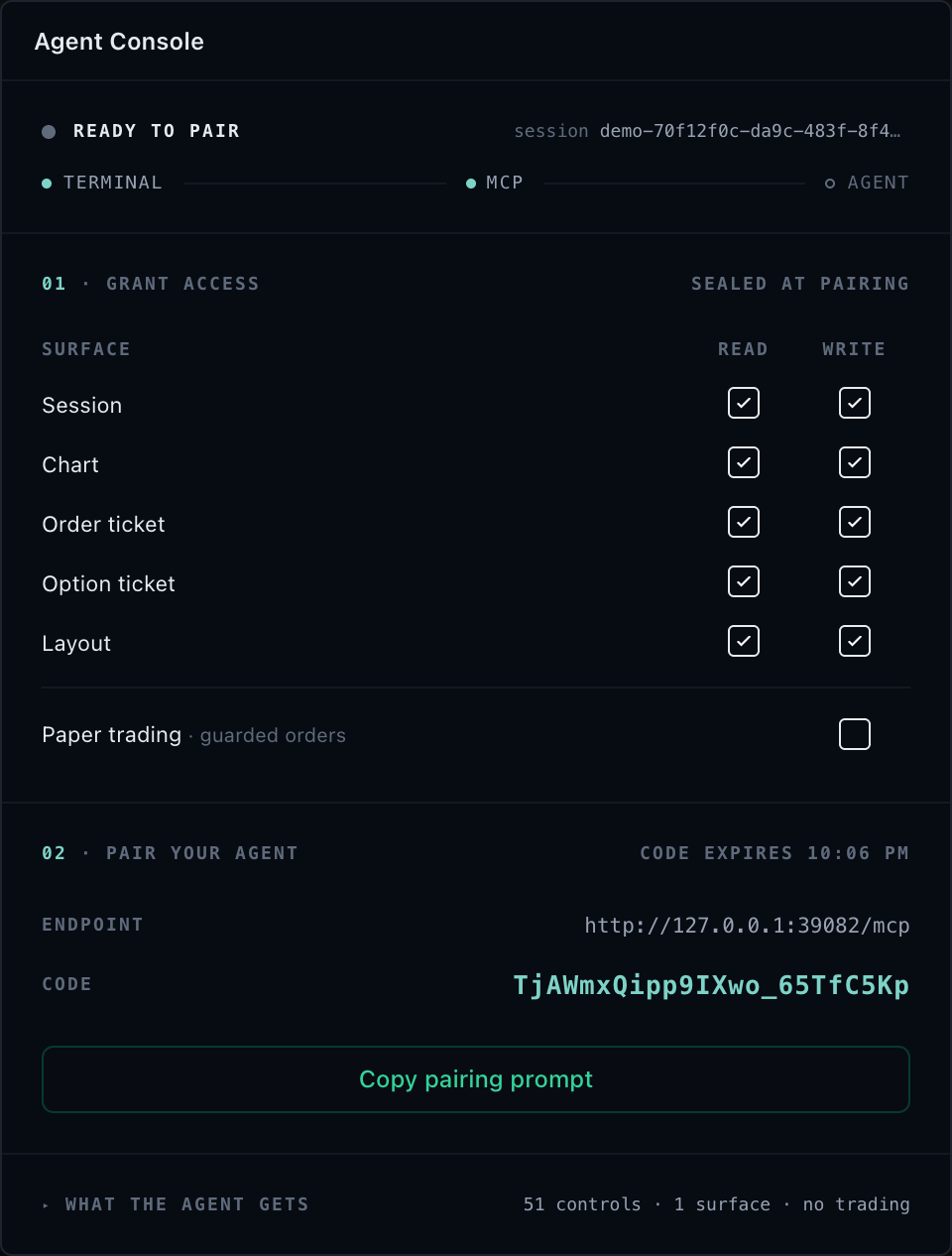
All three recipes use the same packages and six MCP tools. They differ only in the infrastructure and controls the customer supplies.
Individual local testing
Use this path for one developer and one browser on the same computer.
- Install
@tradescript/pro,@tradescript/react-widgets, and@tradescript/chart-mcp. - Start
npx tradescript-chart-mcp stdiofrom the MCP client. - Attach the browser to the printed loopback WebSocket URL with the printed process token.
- Mount Agent Console with
{ kind: 'loopback' }and begin read-only. - Mount a customer-owned paper broker only when testing simulated orders.
- Stop the process and detach the browser to revoke the session.
This path has no remote domain, customer database, model backend, or TradeScript runtime dependency. Do not expose the loopback bridge publicly.
Small hosted business
Use this path for one customer domain and a bounded user population.
- Run the generic gateway container on the customer's HTTPS/WSS origin.
- Authenticate issue, revoke, rotation, and MCP requests through the customer's existing identity layer.
- Implement
SelfHostedSessionStorein the customer's database or Redis. - Start in single-replica mode, or provide a shared bridge router before enabling more replicas.
- Restrict
allowedOriginsto the exact customer application origin. - Send audit events and metrics to customer-owned observability and retention.
- Connect
AgentChatWidgetonly to the customer's model backend; keep provider keys server-side. - Certify paper-order lifecycles and revoke behavior before onboarding users.
Enterprise multi-tenant
Use this path when tenants, principals, regions, or replicas must be isolated.
- Bind every session to authenticated
tenantIdandprincipalIdfacts. - Supply a shared atomic
SelfHostedSessionStoreand sharedSelfHostedBridgeRouter. - Run multiple gateway replicas behind TLS and session affinity for Streamable HTTP MCP sessions.
- Authorize every issue, rotate, revoke, bridge, MCP connection, and MCP request against the bound tenant and principal.
- Partition audit, logs, retention, encryption keys, and incident access by the customer's governance rules.
- Test cross-replica routing, tenant-confusion attempts, hostile origins, expiry, token rotation, immediate revocation, shutdown, and regional failover.
- Pin the selected model campaign and publish the complete control matrix,
traces, package hashes, and chat-provider HTTP-fetch evidence for each
release. Package evidence must include all three
.tgzartifacts; the QA API opens each packed manifest and verifies its claimed identity, version, required public entries, binary entries, and target files before hashing. Capture MCP, browser attachment, WebSocket, and fixture traffic separately before claiming whole-flow network egress.
TradeScript supplies the libraries and generic examples only. Product-boundary and financial wording still require the customer's legal and compliance review; this architecture does not guarantee a regulatory exemption.
Related pages
- Deploy MCP on customer infrastructure for the production gateway contract.
- Agent Chat for the customer-owned model path.
- Review MCP security for tenant, origin, credential, policy, and incident boundaries.